When Your Leonardtown Business Depends on Steady Comfort
Picture a Monday morning in a Leonardtown medical office. Patients begin arriving before the front desk finishes their first cup of coffee, and the waiting room fills fast. If the temperature drifts, phones start ringing with complaints, and staff productivity drops. A commercial heating and cooling system is what keeps that scenario from happening. It works quietly in the background, holding conditions steady across every room, every hour the doors stay open.
At T. N. Bowes Heating & Air Conditioning, Inc., we design, install, and service commercial HVAC systems for businesses that cannot afford to leave comfort to chance. As a family-owned air conditioning company serving Leonardtown, MD, and the surrounding area, we have spent decades learning how commercial buildings behave under load, how equipment ages, and how to keep operating costs predictable. Since 1988, business owners across southern Maryland have chosen us because we pair highly trained technicians with quality products and honest, competitive service.
Why Commercial Equipment Demands a Different Approach
A commercial system is not simply a larger version of a home unit. The equipment moves far more air, cycles more often, and must respond to conditions that change throughout the day. A conference room that holds two people at 8 a.m. may hold forty by 10 a.m. Kitchen equipment throws off heat. Large windows admit solar gain in the afternoon. Server rooms produce a steady heat load that never lets up. A commercial system has to balance all of these zones at once without wasting energy.
Because of this, sizing is a technical exercise, not a guess. We calculate the building load using square footage, ceiling height, insulation values, window orientation, occupancy patterns, and the internal heat produced by equipment and lighting. An oversized unit short-cycles, wears out early, and never dehumidifies properly. An undersized unit runs constantly and still falls short on the hottest days. Getting the calculation right is the foundation of everything that follows, and it is where T. N. Bowes Heating & Air Conditioning, Inc. puts careful attention before any equipment is ordered.
Systems We Install and Maintain Across Leonardtown
Different buildings call for different equipment. A single-story retail space and a multi-tenant office building rarely use the same design. We work with the full range of commercial equipment, matching the system to the structure and the way the space is used.
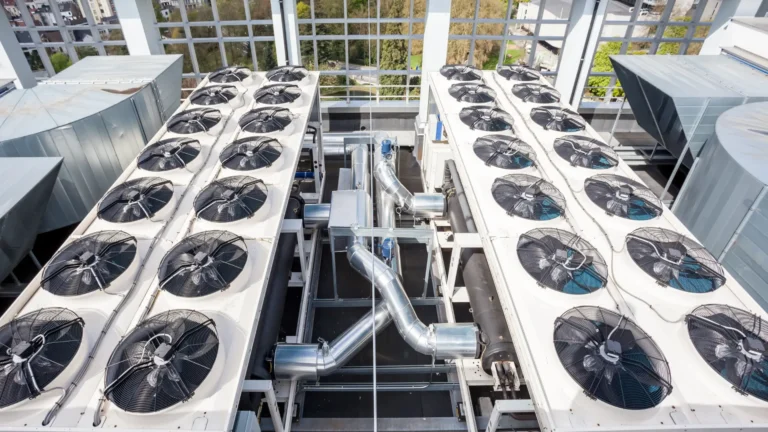
- Rooftop package units: These self-contained systems house the compressor, condenser, and air handler in one cabinet on the roof. They save interior floor space and simplify service access, which makes them a common choice for retail, restaurants, and warehouses.
- Split systems: When roof mounting is not practical, a split system separates the condenser outside from the air handler inside. This layout suits smaller offices and buildings where quiet operation and flexible placement matter.
- Ductless mini-splits: For additions, converted spaces, and rooms with unusual loads such as server closets, ductless units deliver targeted cooling and heating without extending existing ductwork.
- Heat pumps: These systems provide both heating and cooling from one unit and run efficiently across most of the southern Maryland climate range, which lowers year-round energy use.
- Furnaces and gas heat: When deep winter cold arrives, gas-fired heating delivers strong, reliable warmth for buildings that need consistent output through the coldest weeks.
Selecting among these options depends on your building, your budget, and how you use the space. We walk you through the trade-offs so the decision is clear, and we never push equipment that does not fit the job.
Scenarios We See in Leonardtown Buildings
Every commercial account brings its own challenges. A restaurant, for example, fights constant heat from cooking lines and needs strong ventilation to clear humidity and odors. We size systems for these kitchens with the extra load in mind, and we pay attention to makeup air so exhaust fans do not pull the building into negative pressure. When a dining room feels stuffy while the kitchen stays comfortable, the fix usually involves balancing airflow between zones rather than replacing equipment.
Office buildings present a different puzzle. Interior offices with no exterior walls hold heat from people and computers, while perimeter offices swing with the outdoor temperature. Zoning and proper thermostat placement solve most of these complaints. Retail spaces deal with doors that open and close all day, letting conditioned air escape, so we design for the added load and recommend strategies that hold comfort near the entrance without overworking the system.
Warehouses and light industrial spaces need cost-effective heating and cooling across large open volumes where precise temperature control is less important than steady, economical operation. For these buildings, we focus on high-efficiency units and controls that keep the space within an acceptable range while limiting energy waste. Medical and dental offices, on the other hand, demand tight temperature and humidity control along with clean air, so filtration and steady airflow move to the top of the priority list.
Installation Done With the Long View in Mind
A commercial installation is only as good as the planning behind it. Before we set a single unit, we review the electrical service, confirm the structural support for rooftop equipment, plan condensate drainage, and map ductwork for balanced airflow. Rushing any of these steps leads to problems that surface months later, so we take the time to do it correctly the first time.
During installation, our technicians verify refrigerant charge, check static pressure across the system, and confirm that airflow matches the design specification for each zone. We test controls, calibrate thermostats, and document the settings so future service work has a reliable baseline. When we hand a system over, it performs the way the calculations promised, and you have equipment ready to serve the building for years.
Keeping Systems Running Through the Seasons
Commercial equipment runs far more hours than residential units, which means it wears faster and benefits from planned maintenance. A rooftop unit exposed to sun, rain, and debris needs regular attention to keep coils clean, belts tight, and electrical connections secure. Small problems caught early, such as a weak capacitor or a clogged condensate line, cost far less to correct than the failures they turn into when ignored.
Our maintenance visits include cleaning coils, checking refrigerant levels, inspecting electrical components, testing safety controls, and replacing or cleaning filters. Clean filters and coils keep the system moving air efficiently, which lowers utility bills and extends equipment life. For businesses that depend on steady operation, this kind of scheduled care is one of the smartest investments you can make in your building.
Why Businesses Across the Region Trust T. N. Bowes Heating & Air Conditioning, Inc.
We built our reputation the slow way, one satisfied customer at a time. Our technicians train continuously so they understand modern equipment and controls, and we install products we stand behind. We serve Leonardtown along with Lexington Park, Hollywood, Leonardtown, Saint Charles, Mechanicsville, La Plata, California, Waldorf, Lusby, Hughesville, White Plains, Bennsville, Brandywine, and Prince Frederick, MD, and we treat every commercial account with the same care whether it is a small storefront or a busy multi-suite building.
When you work with T. N. Bowes Heating & Air Conditioning, Inc., you get a partner who understands the demands your building places on its heating and cooling systems. We answer questions clearly, explain your options without pressure, and deliver work that holds up. To discuss a new installation, a system upgrade, or a maintenance plan for your Leonardtown business, reach out to our team and let us show you why customers have chosen us over other HVAC contractors in southern Maryland since 1988.