
Keeping Hollywood Commercial Properties Running Without Interruption
A commercial building rarely gives you advance warning before something goes wrong. One week the rooftop unit cycles normally, and the next it struggles to keep a dining room comfortable during a lunch rush. For property managers, retail owners, restaurant operators, and office tenants in Hollywood, MD, the difference between a smooth operating day and a lost one often comes down to how well the mechanical systems are maintained. That is the gap commercial maintenance is designed to close, and it is the work T. N. Bowes Heating & Air Conditioning, Inc. has refined over decades of serving southern Maryland businesses.
Maintenance is not a single task. It is an ongoing relationship with your equipment, built on scheduled attention, accurate record-keeping, and a technician’s trained eye catching small problems before they turn into expensive ones. We approach every service agreement as a long-term partnership, because a building that is cared for consistently simply performs better, costs less to run, and lasts longer than one that only gets attention when something stops working.
Why Scheduled Maintenance Matters More for Commercial Buildings
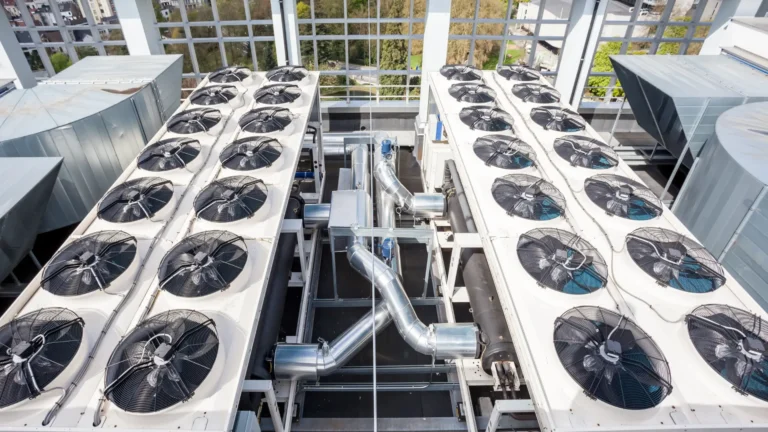
Commercial HVAC equipment works harder than residential systems. A rooftop package unit serving a storefront may run nearly continuous hours during summer, moving large volumes of air through ductwork that stretches across an entire floor plate. The components inside those units—compressors, blower motors, contactors, capacitors, and heat exchangers—experience wear at a pace that matches their workload. Without regular service, that wear accelerates, and a part that might have been cleaned or adjusted during a routine visit instead fails under load.
There is also a financial logic behind consistent maintenance. Dirty coils force a compressor to work against higher pressures, which raises energy use month after month. Clogged filters restrict airflow and strain the blower. A refrigerant charge that drifts out of specification quietly reduces capacity while increasing operating cost. Each of these conditions is invisible on a day-to-day basis, yet together they can inflate a building’s utility bills significantly. When T. N. Bowes Heating & Air Conditioning, Inc. services a system on a planned schedule, we catch these drifts early and correct them, so the equipment operates at the efficiency it was designed to deliver.
What Our Commercial Maintenance Visits Include
Every maintenance visit follows a disciplined sequence rather than a casual once-over. We inspect, clean, test, and document, so that each piece of equipment is evaluated against the standards the manufacturer intended. The goal is to leave a system in measurably better condition than we found it, and to give the building owner a clear picture of its current health.
During a typical service agreement visit, our technicians carry out the following core tasks:
- Coil cleaning and inspection: We clear condenser and evaporator coils of dirt, pollen, and debris that insulate the surfaces and reduce heat transfer.
- Filter replacement and airflow checks: We install correct filters and verify that air is moving at the proper volume through the ductwork and registers.
- Electrical component testing: We measure voltage, amperage, and connection integrity on motors, contactors, and capacitors to catch components nearing the end of their service life.
- Refrigerant and pressure verification: We confirm the charge matches specification and look for signs of leaks that would otherwise rob the system of capacity.
- Drainage and condensate management: We clear condensate lines and pans to prevent water damage and mold growth inside the unit or above a ceiling.
- Thermostat and control calibration: We verify that controls read accurately and that the system responds to them as intended.
After each visit, we provide a record of what was tested, what was adjusted, and what we recommend watching. That documentation becomes a maintenance history that helps you plan for eventual replacements rather than being surprised by them.
Common Scenarios We Handle Across Hollywood Businesses
No two commercial properties carry the same demands, and the value of a maintenance program shows up differently depending on the building. A restaurant in Hollywood, MD, for example, lives or dies by its ability to keep a dining room comfortable while a hot kitchen pushes heat into the space. For these clients, we pay close attention to make-up air, exhaust balance, and the extra cooling load that cooking equipment generates. A system that is simply “working” is not enough when a packed dining room on a July evening tests it to its limit.
Retail spaces present a different challenge. Foot traffic, large glass storefronts, and frequent door openings create fluctuating loads throughout the day. A maintenance program for a retail tenant focuses on keeping the system responsive and efficient so the sales floor stays inviting without driving utility costs beyond what the business can absorb. We also watch for airflow imbalances that leave certain areas too warm or too cold, since customer comfort directly affects how long people stay and shop.
Professional offices and medical suites add their own requirements. Consistent temperature and humidity are not luxuries in these settings—they protect sensitive equipment, keep staff productive, and in healthcare environments contribute to patient comfort and air quality. For these buildings, we prioritize steady performance and quiet operation, and we track filtration closely because indoor air quality carries real weight in a space where people spend their entire workday.
Warehouses, light industrial facilities, and multi-tenant buildings round out the properties we service throughout the region. Each requires a maintenance plan matched to its usage patterns, square footage, and the equipment already in place. We build these plans around the actual building rather than applying a one-size schedule to every client.
The Methodology Behind a Reliable Maintenance Program
Good maintenance begins with understanding the equipment before any wrench is turned. When we take on a new commercial account, we document every unit, its age, its capacity, and its service history where available. This inventory lets us set realistic maintenance intervals—more frequent attention for older or heavily loaded equipment, and standard intervals for newer systems still within their prime years.
From there, we schedule visits to align with the seasons that stress the equipment most. Cooling systems receive thorough attention before summer arrives, and heating systems are inspected and prepared before the first cold spells. This seasonal rhythm means a system is ready for its hardest work before that work begins, rather than being tested cold during the first heavy demand. The result is fewer surprise breakdowns and a more predictable operating budget.
Why Southern Maryland Businesses Choose T. N. Bowes Heating & Air Conditioning, Inc.
We are a family-owned air conditioning company that has served Leonardtown, MD, and the surrounding communities since 1988. Over that time, we built our reputation the only way a service business can—by using highly trained technicians, installing quality products, and delivering excellent service at a competitive price. Customers across southern Maryland have chosen us over other HVAC contractors for more than three decades, and much of that loyalty comes from the consistency of our maintenance work.
When you partner with T. N. Bowes Heating & Air Conditioning, Inc. for commercial maintenance in Hollywood, MD, you gain a team that knows your building, documents its condition, and treats its reliability as a shared responsibility. We serve a wide service area that includes Lexington Park, Hollywood, Leonardtown, Saint Charles, Mechanicsville, La Plata, California, Waldorf, Lusby, Hughesville, White Plains, Bennsville, Brandywine, and Prince Frederick, MD, and we bring the same care to every property regardless of its size. If you want your commercial systems to run efficiently, last longer, and spare you the disruption of unexpected failures, we would welcome the opportunity to build a maintenance plan around your building and its needs.