
Reliable Commercial Installation Services for Businesses in Brandywine, MD
A rooftop unit mounted above a Brandywine retail space must do more than cool the sales floor. It has to handle the heat load from display lighting, the constant swing of entry doors, and the body heat of a crowd on a busy afternoon. Getting that balance right starts long before any equipment arrives on site. It starts with measurement, calculation, and a clear understanding of how the building will actually be used.
At T. N. Bowes Heating & Air Conditioning, Inc., commercial installation work in Brandywine, MD follows a disciplined sequence from first site visit to final startup. Every stage builds on the one before it, and skipping steps is where many installations go wrong. Below, we walk through how we move a commercial project forward, the equipment we work with, and the situations that shape the decisions we make.
Stage One: Surveying the Building and the Load
Before we recommend a single piece of equipment, we survey the space. We measure square footage, ceiling height, window area, and insulation values. We note how many people occupy the building during peak hours and what kind of equipment runs inside it. A print shop with large-format machines produces far more heat than a quiet law office of the same size, and the system we specify has to account for that difference.
This survey feeds a load calculation. Rather than guessing at tonnage, we calculate the exact cooling and heating demand in British thermal units per hour. An oversized system short-cycles, wears its compressor prematurely, and fails to remove humidity properly. An undersized system runs constantly and never reaches setpoint on the hottest days. The goal is a match that holds comfortable conditions efficiently across the full range of Maryland weather.
Stage Two: Selecting Equipment That Fits the Application
Once we know the load, we choose equipment suited to the building and the budget. Commercial work in Brandywine covers a wide range of system types, and each has its place:
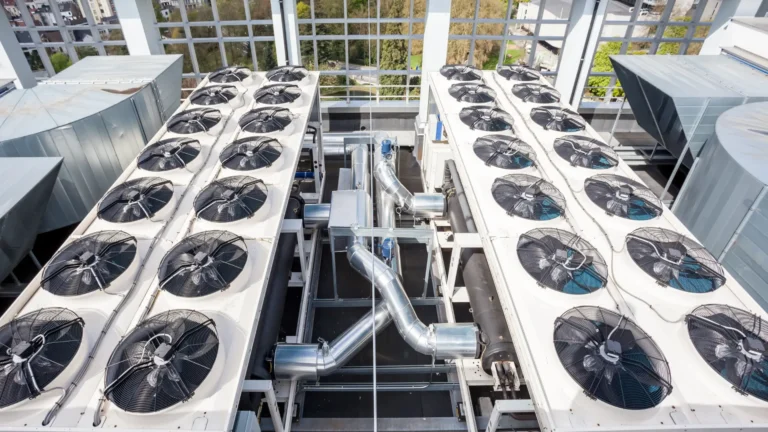
- Packaged rooftop units: Self-contained systems that combine the compressor, condenser, and air handler in one cabinet. They keep mechanical equipment off the floor and are a common choice for retail, restaurants, and single-story commercial buildings.
- Split systems: A separated condenser and indoor air handler, useful where roof space is limited or where quieter indoor operation matters.
- Multi-zone systems: Equipment that lets different areas of a building hold different temperatures, ideal for buildings where offices, storage, and public areas have separate comfort needs.
- Gas and electric heating options: Furnaces, heat pumps, and dual-fuel arrangements chosen based on the building’s energy service and the owner’s operating cost priorities.
We install quality products because long-term reliability saves money that a cheaper upfront choice does not. Since 1988, this focus on durable equipment and correct sizing has been central to how we work. T. N. Bowes Heating & Air Conditioning, Inc. built its reputation on installations that keep performing years after the trucks leave the parking lot.
Stage Three: Ductwork, Controls, and Integration
The equipment is only part of the system. Ductwork carries the conditioned air, and poorly designed ducts waste a large share of what the unit produces. We size supply and return runs to match the airflow the equipment is rated to move, and we seal joints to limit leakage into unconditioned spaces like ceiling plenums. In a commercial building, balanced airflow means every zone receives its share of heating and cooling rather than one area staying cold while another stays stuffy.
Controls tie the whole system together. Programmable thermostats and building management interfaces let an owner set schedules that match business hours, so the system eases back during closed periods and recovers before staff arrive. For buildings with multiple units, coordinated controls prevent equipment from fighting one another. We configure these controls during installation and confirm they respond correctly before we consider the work finished.
Stage Four: Startup, Testing, and Verification
Mounting equipment and connecting ducts is not the end of a commercial installation. The final stage is startup and verification, and it is where careful work shows its value. We charge refrigerant to the manufacturer’s specification, check static pressure across the air handler, and measure temperature split between supply and return air. These readings tell us whether the system is performing as designed or whether something needs adjustment.
We also verify safety controls, test the heating and cooling cycles under load, and walk the owner through the controls so staff know how to operate the system day to day. A proper handoff reduces service calls later and helps the owner get the efficiency they paid for. Documentation of the installed equipment and its settings gives future technicians a clear baseline to work from.
Situations We Regularly Handle in Brandywine
Commercial installation rarely means a blank slate. Most of the work involves fitting new equipment into existing buildings with their own constraints. A few patterns come up again and again:
- Replacing a failed aging unit: An owner calls after a rooftop unit stops working. We assess whether the existing ductwork and electrical service can support a modern replacement, then plan the swap to limit downtime.
- Expanding into new space: A business takes over an adjacent suite and needs climate control extended or a separate system added. We calculate the added load and decide whether to extend the current system or install dedicated equipment.
- Upgrading for efficiency: A building with older equipment faces rising operating costs. We compare the cost of running outdated equipment against the savings a modern high-efficiency system delivers.
- Correcting a poor prior installation: Undersized ducts, bad airflow, or equipment that was never matched to the load. We diagnose the root cause and rebuild the system so it performs the way it should.
Each of these starts the same way, with measurement and honest assessment rather than a quick quote on whatever unit happens to be in stock. Brandywine businesses depend on steady conditions, and the right approach at the start prevents problems that are expensive to fix later.
Why Businesses Across Southern Maryland Choose Us
T. N. Bowes Heating & Air Conditioning, Inc. is a family-owned air conditioning company serving Leonardtown, MD, and the surrounding area, including Brandywine. We built our outstanding reputation by using highly trained technicians, installing quality products, and delivering excellent service at a competitive price. For commercial work, that combination matters even more than it does in a home, because a business cannot afford a system that fails during peak hours or wastes money month after month.
Our technicians stay current with the equipment and the codes that govern commercial installation. When we hand over a finished system, it is sized correctly, installed to specification, and verified under load. Since 1988, customers across Lexington Park, Hollywood, Leonardtown, Saint Charles, Mechanicsville, La Plata, California, Waldorf, Lusby, Hughesville, White Plains, Bennsville, Brandywine, and Prince Frederick, MD have chosen us over other HVAC contractors in southern Maryland for exactly this reason, and we bring the same standards to every commercial project in Brandywine.
Starting Your Commercial Installation
A successful commercial installation begins with a conversation about how your building is used and where the current system falls short. From there, we survey, calculate, specify, install, and verify, keeping you informed at each stage so there are no surprises. The result is a climate control system matched to your building rather than a generic solution forced to fit.
Whether you are replacing failing equipment, outfitting a new space, or upgrading for better efficiency, T. N. Bowes Heating & Air Conditioning, Inc. brings decades of hands-on experience to commercial installation in Brandywine, MD. Reach out to discuss your project, and we will put the same attention to detail into your building that has earned the trust of businesses throughout the region.